
For many students, learning a concept in a classroom and actually understanding how it works in the real world are two different things. The gap becomes even more visible when students move from school to college and eventually begin looking for internships and jobs.
In Salem, startup Sashainfinity is working around this gap with a combination of technology, practical learning and industry exposure. The company is developing solutions around augmented reality (AR), virtual reality (VR), education and practical training, while also building a hybrid learning model for students.
According to the company's team, its broader objective is to help students understand concepts practically in school and gain industry-oriented experience before they enter the workforce.
The Problem Sashainfinity Wants to Solve
Parents invest in their children's education with the expectation that it will eventually help them build a career. But according to Sashainfinity's HR Manager Sridhar, students can still struggle to connect what they learn in classrooms with practical applications.
The challenge exists at different stages.
In schools, students may be taught concepts with an emphasis on practical learning, but understanding how to apply those concepts can remain difficult. At the college level, the challenge shifts toward employability.
Engineering students may be expected to secure placements in IT companies, while students from arts and other streams are also expected to find jobs aligned with their skills.
The question, as Sridhar explains it, is not simply whether students are educated, but whether they have the practical exposure needed to move from education into employment.
This becomes particularly relevant for students in Tier-2 and Tier-3 cities, where the company believes there is still a gap in awareness and access to industry exposure.
How the Idea Took Shape
Sashainfinity is led by founder Sharweshwar, with the company building a team around technology, education and practical learning.
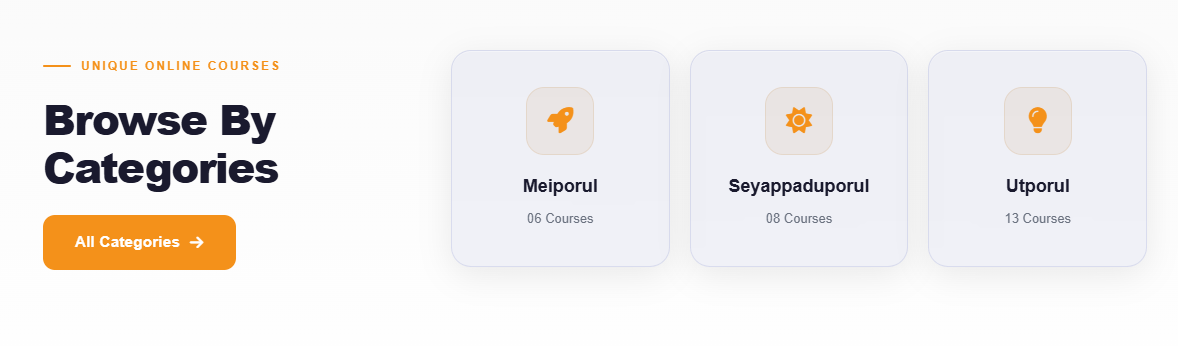
The company currently has multiple areas of focus, which it describes through three models: மெய்ப்பொருள், உட்பொருள் and செயப்படுபொருள். Each addresses a different stage of the learning and career journey.
மெய்ப்பொருள் focuses on AR and VR-based learning for schools. The idea is to use immersive technology to help students understand subjects such as mathematics and science through interactive experiences.
உட்பொருள் focuses on college students and practical industry exposure.
செயப்படுபொருள் is being developed as a technology-enabled hybrid tuition model, initially focused on school mathematics and with plans to eventually expand into competitive-exam coaching.
Together, these models form the company's broader approach to education and employability.
Using VR to Make School Concepts More Practical
One of Sashainfinity's key technology-focused offerings is its AR/VR learning model for schools.
The company plans to set up lab-style environments in schools where students can use immersive technology to understand mathematics and science concepts.
The goal is not simply to add VR headsets to a classroom. Instead, the team is attempting to create interactive models that allow students to see and engage with concepts that can otherwise be difficult to visualize.
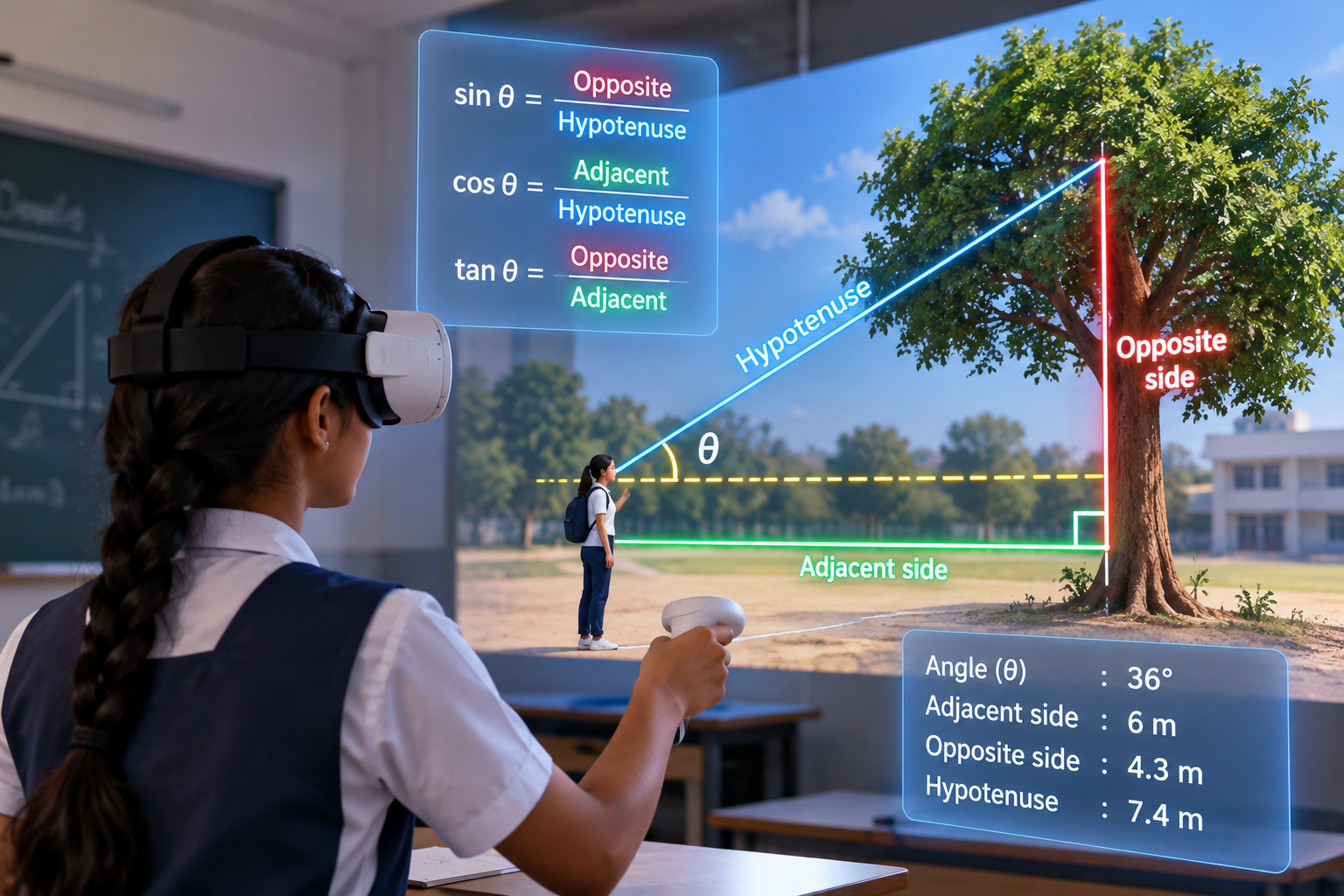
In a conventional classroom, students may learn about the opposite side, adjacent side and hypotenuse of a right-angled triangle, along with formulas involving sine, cosine and tangent. Sashainfinity's VR model attempts to turn that abstract concept into an interactive experience.
"Once they understand which is the adjacent side, which is the opposite side, which is the hypotenuse, and which formula to use, they won't forget it."
From Mathematical Models to VR Experiences
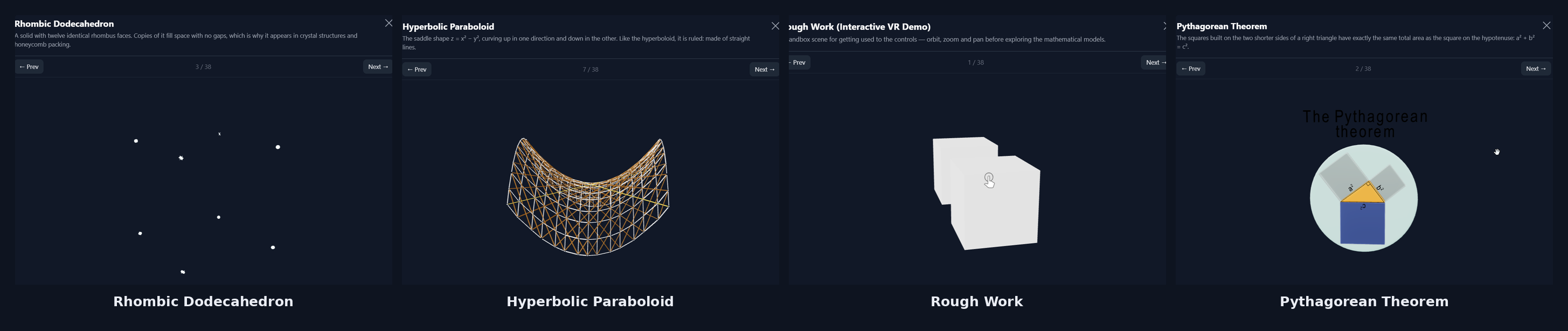
Mathematical concepts can be transformed into interactive 3D experiences using Blender and Unity. 3D models help students visualize complex shapes instead of relying only on textbook diagrams.
The Pythagorean Theorem can be explored through an interactive geometric model.
Shapes such as the Rhombic Dodecahedron can be rotated and examined from different angles. The Hyperbolic Paraboloid makes complex mathematical surfaces easier to understand visually.
Testing the Idea With Students
Before scaling the VR learning model, Sashainfinity has already tested one of its experiences with students. The company participated in a science expo in Dindigul, where around 600 school students took part in its VR trial.
According to the team, the trial generated positive feedback. Mathematics teachers who observed the demonstration were particularly interested in how a concept such as trigonometry could be presented in a simpler and more interactive way.
This early trial gave the team an opportunity to observe how students and teachers responded to the technology before taking the product further.
Three Different Audiences, Three Different Models
Sashainfinity currently identifies three broad target audiences for its different offerings.
Schools: மெய்ப்பொருள்
The Meipporul model is focused specifically on schools. The company plans to provide lab-style setups where students can use AR and VR to understand mathematics and science concepts.
The immediate focus is therefore on making classroom concepts easier to visualise and understand.
College Students: உட்பொருள்
The second model is aimed at college students. The company believes students often start thinking seriously about placements only when they reach their final year. Its approach is to introduce practical exposure earlier.
Students in their second and third years can participate in internships and learn by working on practical projects within the company. Instead of only sitting in a classroom and listening to instructors, interns can work on actual tasks and gain experience with tools and workflows.
The company has also started running courses under this model and plans to introduce workshops in the future.
Hybrid Learning: செயப்படுபொருள்
The third model is a hybrid tuition-centre concept. At present, the focus is on mathematics concepts for school students. In the future, the company plans to explore coaching for government examinations such as UPSC and Tamil Nadu's Group 1, Group 2, Group 3 and Group 4 examinations.
The longer-term idea is to combine conventional coaching with technology rather than operate like a traditional tuition centre.
Taking the Product to Colleges
While the company's school-focused AR/VR offering is still being developed, its current go-to-market activity is primarily focused on the college segment. The company uses LinkedIn to identify colleges in and around Salem and approach them directly.
The process is relatively straightforward. The team first identifies colleges that could be relevant, reaches out to them through LinkedIn and introduces Sashainfinity's services.
If the college responds positively, the company follows up with a formal email and proposal. Once the institution agrees and the necessary documentation is completed, the company provides its services.
For a young startup, this direct institutional approach allows the team to test demand without relying solely on large-scale marketing campaigns.
The Challenge of Building From a Tier-2 City
Sashainfinity is being built in Salem, a Tier-2 city, and the team says the challenge is less about starting a startup and more about converting potential customers into actual users.
The company sees awareness as a particularly important issue when it comes to Tier-3 institutions and students.
According to Sridhar, there can be a significant difference in placement awareness and expectations between institutions in Tier-1 cities and those in smaller cities. The company's challenge, therefore, is to bridge that awareness gap and demonstrate the value of practical learning.
At the same time, being part of the Tier-2 startup ecosystem has provided the company with access to local networks.
Support From Sona Incubation Foundation
Sashainfinity is an incubated startup at Sona Incubation Foundation. The company has access to a co-working space alongside other startups, creating opportunities for networking and collaboration.
For example, another startup may already have worked with a particular institution and could recommend Sashainfinity's services. Such relationships can reduce the distance between a young startup and decision-makers at educational institutions.
From Classroom Concepts to Practical Experience
Sashainfinity's journey is still taking shape, but the company has already begun experimenting with a different way of connecting education with practical experience. From testing VR-based learning with around 600 school students to providing internships for college students, its focus is on helping learners move beyond simply understanding concepts in a classroom.
The larger vision is to bridge the gap between what students learn, what they can practically apply, and how prepared they are for the world of work. Its plans around VR learning, practical courses, internships and technology-enabled education point towards an attempt to make learning more interactive and industry-oriented.
For students interested in exploring Sashainfinity's courses and developing practical skills, the company is offering 10% off on its courses with the code HUSTLOOP10.
Students can explore the available programs on the https://www.sashainfinity.com .