
For many parents, feeding a growing child is not simply about putting food on the table.
The difficult questions often come afterward:
What should I give my child? How do I prepare it? Am I giving the right combination of nutrients? And can I realistically prepare nutritious food every day?
This is the problem that Grainy Foods is built around.
The Salem-based food company develops health-focused, convenient food products using traditional grains, millets, fruits, nuts and other ingredients. What started in 2018 with a single Sprouted Health Mix has expanded into a portfolio of more than 30 products across health mixes, ready-to-drink products, breakfast cereals, millet-based noodles and sevai.
But the company's core proposition is not simply about selling healthy food. It is about making nutritious food easier for families to access, prepare and include in everyday life.
The Problem: Parents Know Nutrition Matters, But Applying It Is Difficult
Parents often understand that children need balanced nutrition. The challenge is translating that understanding into everyday meals.
Different grains and ingredients provide different nutrients, and combining them appropriately can require knowledge, planning and preparation. According to Grainy Foods' original customer interactions, parents looking for nutritious food options were not only asking what ingredients were healthy but also how those ingredients could be formulated into practical foods for their children.
This creates a gap between knowing what is nutritious and actually providing it consistently.
For a busy parent, preparing multiple ingredients, understanding nutritional combinations and developing different foods for different age groups can become difficult.
That is the gap Grainy Foods is attempting to address.
Turning Nutritional Knowledge Into Convenient Food Products
Grainy Foods approaches the problem through formulated food products rather than leaving parents to figure out the combinations themselves.
Its product development considers different nutritional requirements and combines ingredients according to the intended use of each product. The company describes its approach as going beyond simply putting individual nutritious ingredients together, instead considering how ingredients work in combination.
The result is a range of products designed to fit into familiar eating occasions.
Instead of asking parents to start from raw ingredients and build every nutritional combination themselves, the company provides products that can be incorporated into everyday meals and drinks.
From One Health Mix to a Broader Food Portfolio
The company's first product was a Sprouted Health Mix. Customer demand subsequently led to additional products designed around different nutritional requirements and age groups. According to the company, this eventually developed into a portfolio of more than 30 products.
The portfolio now covers several categories.
Health Mixes
The health-mix range includes products such as:
Sprouted Health Mix
Sprouted Black Gram Health Mix
Millet-based health mixes
Karuppu Kavuni-based health mix
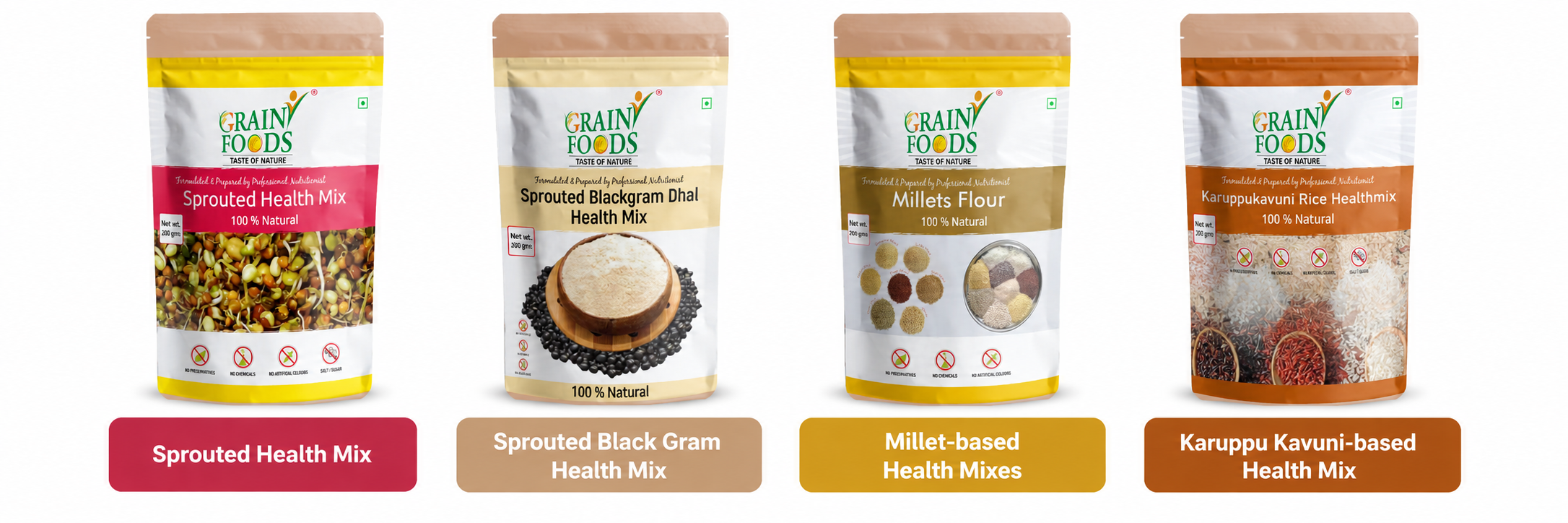
These products are positioned as convenient ways to incorporate combinations of grains and other ingredients into the diet.
Ready-to-Drink Products
Another part of the portfolio focuses on drinks that can be mixed with milk or water.
Products mentioned by the company include:
ABC - Apple, Beetroot and Carrot
Nutri Boost
Beetroot-based products
Red banana or Sevvazhai-based products
Carrot-based products
Dates powder
Dates, nuts and seeds-based products
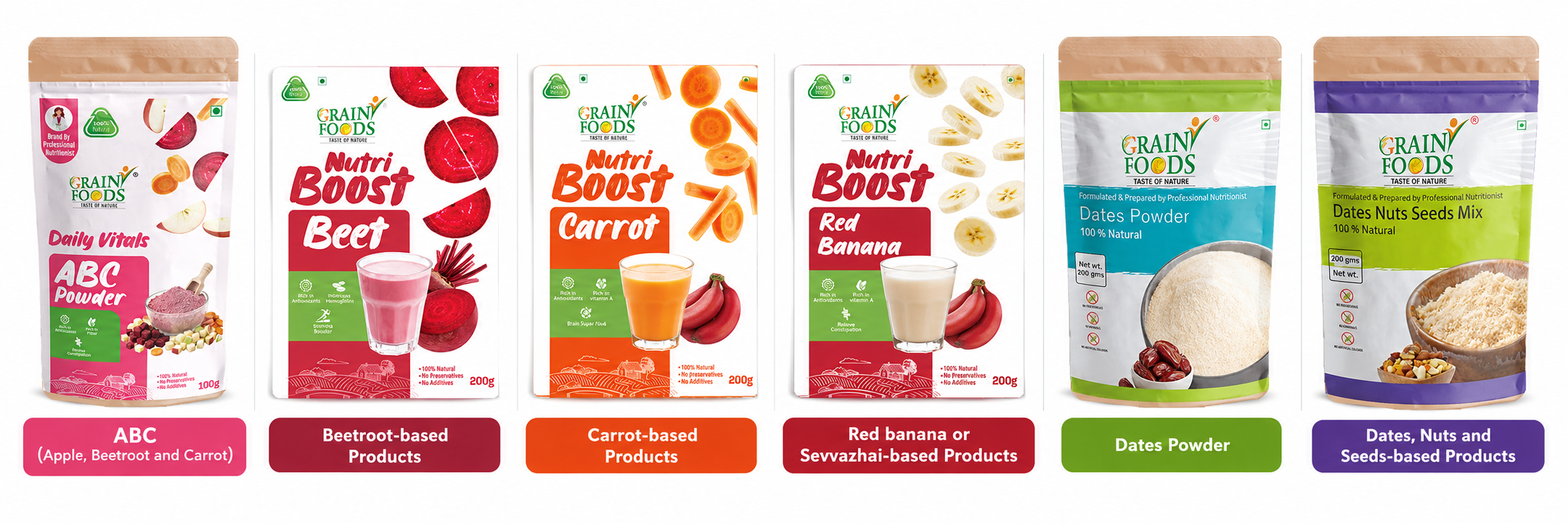
The problem being addressed here is convenience: providing nutrition-focused formulations that can be consumed as drinks without requiring parents to prepare the ingredients from scratch.
Startup Incubation Support
Grainy Foods also benefited from Salem's startup ecosystem, including StartupTN, Sona College's incubation centre, TN-RISE Women Start Up Council and Periyar University's incubation centre. These programmes provide entrepreneurs with guidance, mentorship and support across areas such as business execution, manufacturing and certifications.

Making Traditional Grains Easier to Include in Modern Diets
Grainy Foods also works with traditional grains and millets. This is particularly visible in its breakfast and noodle categories.
The company makes instant breakfast cereals using ingredients such as millets, oats, dry fruits and nuts. Its products include Chocos made using Poongar rice and different varieties of millet-based muesli.
The company also produces millet-based noodles using varieties including:
Varagu
Samai
Thinai
Kuthiraivali
Multigrain
Kollu
It also produces millet-based sevai using varieties such as Varagu, Samai, Thinai, Kuthiraivali and multigrain formulations. The underlying idea is straightforward:
Traditional grains can be nutritionally useful, but they need to be available in forms that fit into the foods people already eat.
Convenience Is Part of the Nutrition Problem
Nutrition is not only about the ingredients themselves. For food to become part of a family's routine, it also needs to be practical.
A parent may know that millets, grains, nuts or certain fruits can contribute to a nutritious diet. But if preparing them requires significant time and effort every day, consistent usage becomes harder.
This is where convenience becomes part of the problem Grainy Foods is trying to solve.
Health mixes, instant cereals, ready-to-drink formulations, noodles and sevai give consumers different ways of incorporating nutrition-focused ingredients into familiar food formats.
The company therefore operates at the intersection of nutrition and convenience.
Different Age Groups Have Different Requirements
Another challenge is that nutritional needs are not identical across all age groups. The
company says it considers nutritional requirements associated with different age groups when developing products.
This means the problem is not simply:
"How do we make healthy food?"
It is closer to:
"How do we create practical food products that address different nutritional requirements and fit into everyday consumption?"
That distinction is important because consumers do not all have the same needs.
Customer Feedback Shapes the Product Range
The expansion from one product to more than 30 products was also influenced by customer feedback.
Customers who used the original health mix asked for additional options designed around different nutritional requirements and age groups. Those requests contributed to the development of new products and categories.
This creates a customer-driven product development loop:
Customer problem → product requirement → formulation → customer feedback → new product
Instead of treating the product catalogue as the goal, the company describes its approach as developing products around specific customer needs.
The Problem Extends Beyond Children
Although child nutrition was an important starting point, the product portfolio now addresses a broader set of everyday food requirements.
The company offers products across:
Health mixes
Ready-to-drink beverages
Breakfast cereals
Muesli
Millet noodles
Millet sevai
This allows the brand to address nutrition and convenience across multiple consumption occasions rather than focusing on a single meal or age group.
Food Safety Is Also Part of the Problem
For packaged food, solving a nutrition and convenience problem is not enough.
Consumers also need confidence that the products meet food-safety and quality requirements.
According to the company, its products are sent to an FSSAI-accredited laboratory before being introduced to the market, with testing that includes nutritional analysis and checks for factors such as heavy metals. The company also states that it obtained FSSAI certification when it started in 2018.
This adds another layer to the consumer problem: People need food that is not only convenient and nutrition-focused, but also produced and tested within the required food-safety framework.
What Grainy Foods Is Ultimately Trying to Solve
At its simplest, Grainy Foods is addressing a gap between nutrition knowledge and everyday implementation.
Parents and consumers may want healthier food options, but turning that intention into convenient daily consumption can require:
Nutritional knowledge
Ingredient selection
Formulation
Preparation time
Variety
Age-specific considerations
Convenient food formats
Grainy Foods attempts to bring these elements together through ready-to-use and easy-to-prepare products.
Its product range reflects that approach: health mixes for nutritional formulations, ready-to-drink products for convenience, cereals for breakfast, and millet-based noodles and sevai for familiar meal formats.
From a Nutrition Problem to a Product Ecosystem
The evolution from one Sprouted Health Mix to more than 30 products shows how the original problem can expand into multiple use cases.
The central question remains the same: How can nutritious ingredients and traditional grains become easier for consumers to incorporate into everyday food?
The answer, in Grainy Food’s case, has been to build products around that problem rather than simply selling individual ingredients. The company's stated direction is to continue developing products around consumer needs while expanding its manufacturing and market reach.
For consumers, the value proposition is therefore less about buying a particular health mix or millet product and more about solving a recurring everyday challenge:
making nutritious food more practical, convenient and accessible.
If you’d like to explore their range of health mixes, ABC drinks, breakfast cereals and millet-based products, visit the Grainy Foods website.
Use the promo code HUSTLOOP to get 10% off your order.