
For generations, Indian households have relied on ingredients such as moringa leaves, curry leaves, hibiscus, and amla to prepare traditional foods and drinks. These ingredients are familiar to many families, but incorporating them into everyday routines can be difficult for people with busy schedules.
This is the problem that Minute Soups is trying to address. Based in Tamil Nadu, Minute Soups is building a range of herbal dip soups inspired by traditional Indian ingredients. Instead of asking consumers to source fresh ingredients, clean them, prepare them, and cook soup from scratch, the company offers a convenient alternative designed for modern lifestyles.
Its initial product range includes six flavours: Moringa, Hibiscus, Blue Pea, Mudakathan, and Amla. Each comes in a dip-bag format intended to make preparation simple.
But Minute Soups is not just attempting to sell another instant beverage. Its business is built around a broader idea: making traditional ingredients easier to incorporate into everyday consumption while paying attention to ingredient sourcing, product consistency, and environmentally conscious packaging.
From Herbal Tea to Dip Soups: How the Product Idea Emerged
Minute Soups began with a different product category in mind. While exploring business opportunities, the team was looking for a refreshing drink that could be consumed during working hours. Neither of the two people initially involved in the business regularly drank tea or coffee, which led them to explore herbal alternatives.
They came across herbal teas made using ingredients such as blue pea flowers and hibiscus. However, the taste did not meet their expectations, particularly when honey was added as a sweetener.
This led to a question: could a refreshing drink be developed using spices and traditional ingredients instead? The team began researching different types of traditional soups, how they were prepared, and what was already available in the market.
During this research, the focus shifted from herbal tea to traditional Indian soups.
The team observed that many familiar household soups were prepared using leaves and other plant-based ingredients. In contrast, people looking for convenience often relied on commercially available packaged soups.
Minute Soups emerged from the idea of bringing these traditional ingredients into a format that would be easier to use in contemporary households and workplaces.
The original concept had evolved from herbal tea into a range of dip soups.
What Are Minute Soups?
Minute Soups offers herbal dip soups made with selected leaves, flowers, and other plant-based ingredients inspired by traditional Indian food practices.
Designed for convenience, Minute Soups comes in an easy-to-use sachet format. Simply dip a sachet into hot water to prepare a warm herbal soup without the need to source, clean, or process the ingredients yourself.
The idea is to make enjoying herbal ingredients a simple part of your everyday routine, with convenient preparation and a variety of flavours to choose from.
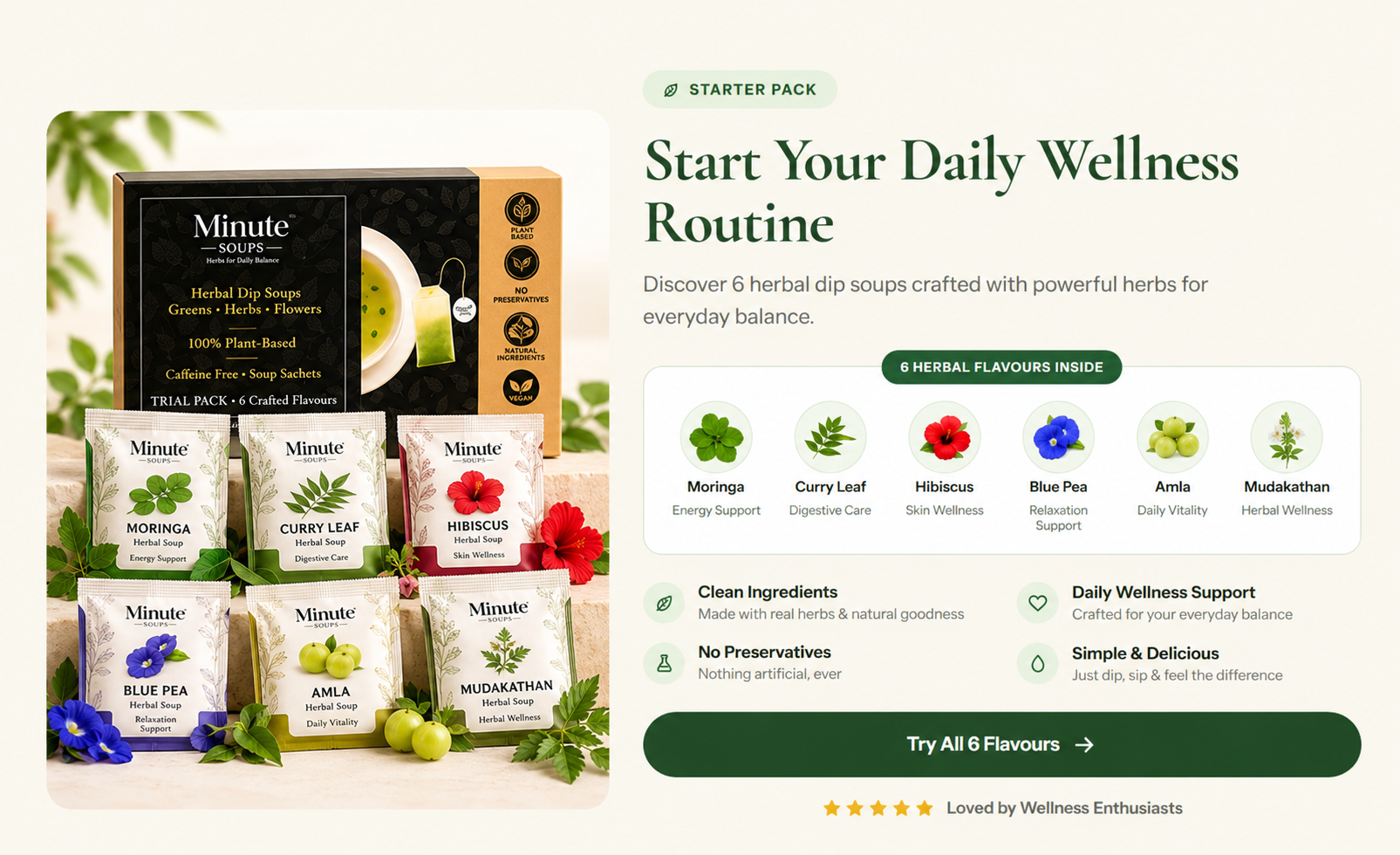
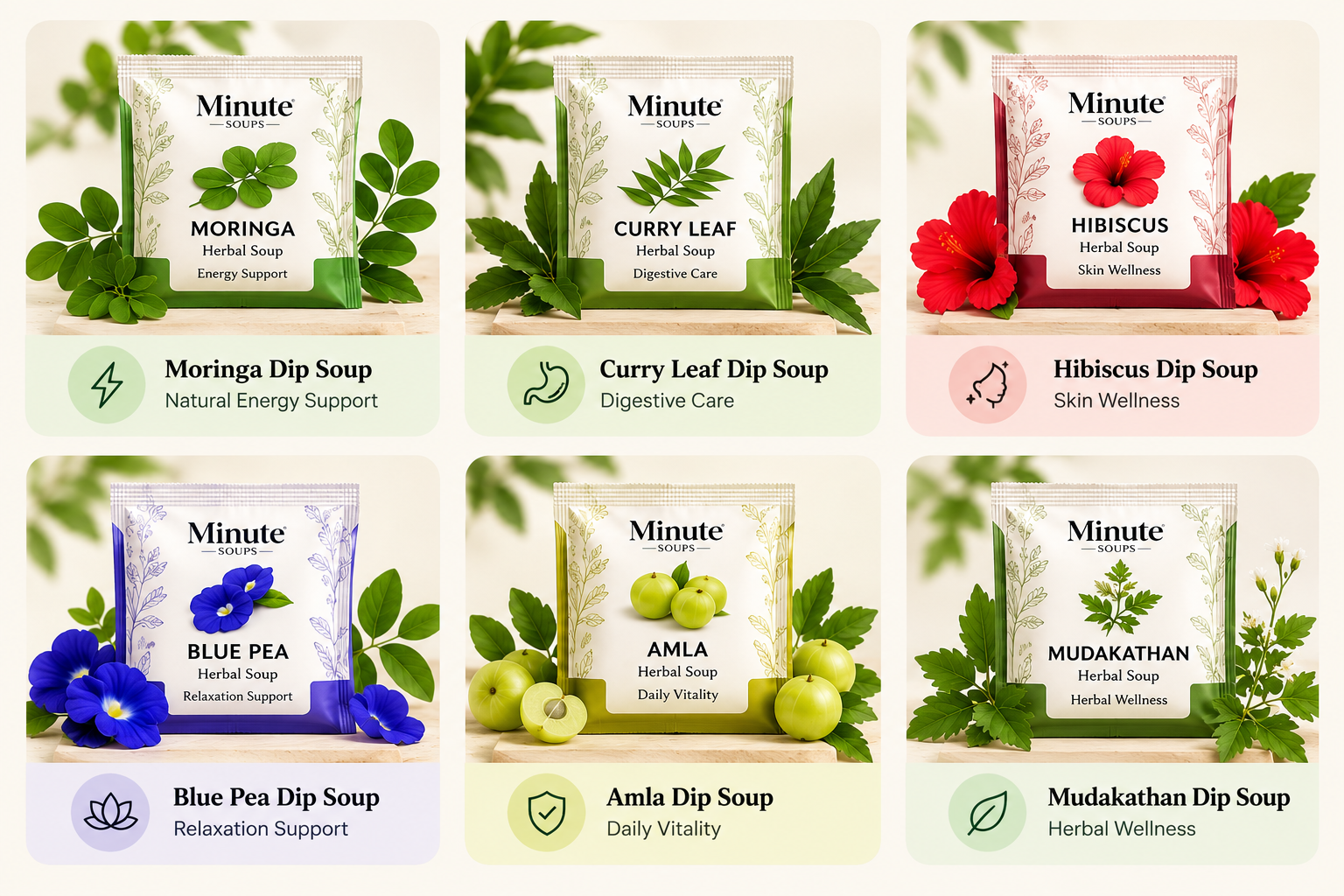
The initial starter pack features six unique flavours: Moringa, Curry Leaf, Hibiscus, Blue Pea, Amla, and Mudakathan.
1. Moringa Dip Soup
Moringa is a familiar ingredient in Indian households, where its leaves are commonly used in traditional cooking.
Minute Soups brings moringa into a convenient dip-soup format, offering an easy way to enjoy its distinctive herbal flavour as part of your daily routine.
Whether you prefer it in the morning or as a warm drink during the day, Moringa Dip Soup offers a simple way to explore this traditional ingredient.
2. Curry Leaf Dip Soup
Curry leaves are widely used in Indian cooking to add aroma and flavour to a variety of dishes, particularly in tempering and seasoning.
With Minute Soups, this familiar ingredient takes on a different form. Curry Leaf Dip Soup offers a convenient way to experience curry leaves in a warm, herbal preparation without the need for traditional cooking.
It is a distinctive option for those who enjoy familiar Indian ingredients in a new format.
3. Hibiscus Dip Soup
Hibiscus is widely recognised for its use in herbal infusions and teas. Its vibrant flowers and distinctive flavour make it an interesting ingredient for herbal beverages.
Minute Soups introduces hibiscus in a dip-soup format, providing a convenient way to enjoy a warm floral infusion.
For those looking to explore herbal flavours beyond conventional tea and coffee, Hibiscus Dip Soup offers something different to add to their daily routine.
4. Blue Pea Dip Soup
Blue pea, also known as butterfly pea, is a flowering plant recognised for its naturally vibrant blue petals.
Minute Soups brings this visually distinctive flower into its herbal dip-soup range. Blue Pea Dip Soup offers a unique way to explore the ingredient in a convenient, warm preparation.
Its striking colour and floral appeal make it an interesting choice for consumers who enjoy discovering new herbal flavours.
5. Amla Dip Soup
Amla, also known as Indian gooseberry, has a long history of use in traditional Indian food practices.
Known for its distinctive tangy taste, amla is commonly used in a variety of Indian preparations.
Minute Soups offers Amla Dip Soup as a convenient alternative way to experience this familiar ingredient. Its inclusion in the starter pack adds another distinctive flavour to the range.
6. Mudakathan Dip Soup
Mudakathan, also known as balloon vine, is a plant traditionally used in parts of South India, particularly in Tamil Nadu cuisine. It is commonly incorporated into traditional preparations, including dosas and other homemade dishes.
Minute Soups brings Mudakathan into an easy-to-prepare dip-soup format, offering consumers a new way to explore this traditional ingredient without the effort of preparing it from scratch. Its inclusion highlights the brand's focus on bringing familiar regional ingredients into a convenient, contemporary format.
Why Minute Soups Introduced a Six-Flavour Starter Pack
For a new consumer, choosing an unfamiliar product can be difficult. Someone visiting Minute Soups' website for the first time may be interested in the concept but unsure which flavour to purchase. Buying several full packs before trying the product could also be an unnecessary commitment.
To address this problem, Minute Soups introduced a starter pack containing all six flavours.
According to the podcast, the starter pack is priced at ₹299. The format allows customers to sample the different varieties before deciding which ones they prefer. Someone who particularly enjoys Moringa, for example, can subsequently purchase a pack of that flavour.
This approach serves two purposes.
First, it reduces the uncertainty involved in trying a new product category. Second, it gives customers an opportunity to discover their preferences before making repeat purchases.
The company has also reported that Moringa accounts for approximately 50% of its customers, although the transcript does not clarify whether this refers to flavour preference, customer purchases, or another measure. For Minute Soups, the starter pack is therefore not just a product bundle. It is also a way to introduce consumers to the broader range.
A Plastic-Free Packaging Approach
Packaging is another area in which Minute Soups says it has made deliberate choices.
According to the company, its dip bags are made from cotton rather than the nylon- or plastic-based materials it says are commonly used in comparable tea-bag formats.
It also describes its outer packaging as plastic-free. These choices contribute to the company's effort to reduce reliance on conventional plastic packaging.
However, alternative packaging materials can increase production costs. Minute Soups says cotton dip bags are considerably more expensive than inexpensive conventional pouches.
The company has also indicated that it is working on certification related to its dip bags.
This means the packaging strategy is connected to both product positioning and operating costs. Choosing a different material affects not only how the product is presented to consumers but also how much it costs to produce. For Minute Soups, the challenge is to balance convenience, packaging preferences, product quality, and affordability.
Pricing: What Goes Into a ₹299 Starter Pack?
Minute Soups has priced its six-flavour starter pack at ₹299, according to the podcast.
The company explains that the price reflects several components of its production process.
These include:
Raw material sourcing: Identifying and obtaining suitable leaves, flowers, and other ingredients.
Farmer relationships: Working with farmers to source ingredients that meet the company's requirements.
Processing: Drying and preparing the raw materials.
Cotton dip bags: Using cotton bags instead of conventional plastic- or nylon-based alternatives.
Packaging: Developing outer packaging that the company describes as plastic-free.
Research and development: Spending time refining the product and its sourcing process.
The company says that alternative packaging materials can cost several times more than conventional pouches. This helps explain why the product's pricing is linked not only to the ingredients but also to the choices made during manufacturing and packaging.
Why Consistency Matters in a Traditional-Inspired Product
Many of the ingredients used by Minute Soups are already familiar to Indian consumers.
Moringa, curry leaves, amla, and hibiscus are not new discoveries. They are ingredients that people may encounter in their homes, gardens, or local markets.
This creates an interesting challenge for the company.
If consumers already have access to these ingredients, why would they purchase them in packaged form?
Minute Soups' answer centres on convenience and consistency. Preparing a soup at home requires sourcing the ingredients, cleaning them, measuring quantities, processing them, and preparing the final drink. The result can also vary depending on the ingredients and preparation method.
Minute Soups aims to simplify that process by providing pre-portioned ingredients in a ready-to-use format. The company says it works to maintain consistency in taste and ingredient selection so that consumers can expect a similar experience when they prepare the product.
Its value proposition is therefore based on three main elements:
Convenience: Reducing the preparation involved in consuming traditional ingredients.
Consistency: Following a controlled sourcing and processing approach.
Transparency: Explaining the ingredients used in each product.
The company is not suggesting that consumers cannot prepare these products at home. Instead, it is offering an alternative for people who prefer a more convenient format.
Building a Business in Tamil Nadu's Startup Ecosystem
Developing a product is only one part of building a consumer business. Finding customers, setting prices, understanding distribution, and preparing for market entry present separate challenges. Minute Soups says that startup ecosystem support helped it navigate some of these early decisions.
According to the podcast, participation in events organised through StartupTN↗, helped the team understand market entry, pricing, and market analysis. The business subsequently connected with BIC@PU :: Periyar University Business Incubation Confederation↗

The support described in the podcast included product analysis, documentation, information about relevant certifications, and guidance on taking the product to market.
The company also received opportunities to display its products at events, including government-related events.
For an early-stage food business, these opportunities can help introduce a product to potential customers and expose the team to questions about pricing, packaging, product quality, and market demand.
Instead, the support described appears to have focused on product readiness, market access, and understanding the practical steps involved in building the business.
How Minute Soups Started Selling Online
Minute Soups has chosen online channels as an important part of its customer acquisition strategy. According to the podcast, the company began introducing its products through several platforms, including:
Amazon
Flipkart
Its own website (Minute Soups↗)
Instagram
For a product that may be unfamiliar to some consumers, this kind of explanation is important. Customers need to understand how a dip soup differs from conventional packaged soup, how it is prepared, and what ingredients it contains.
What Makes Minute Soups Different?
Minute Soups operates in a product category that combines familiar ingredients with a less familiar format.
Its differentiation, based on the podcast, comes from several decisions working together.
Traditional Ingredients in a Convenient Format
The company uses ingredients such as moringa, curry leaves, hibiscus, blue pea, and amla in individual dip bags.
This format aims to make the ingredients easier to consume without requiring customers to prepare the raw materials themselves.
Attention to Ingredient Varieties
The company says it examines the varieties and quality of its raw materials, particularly for ingredients such as hibiscus.
It also describes working with farmers as part of its sourcing approach.
Cotton Dip Bags
Minute Soups says it uses cotton dip bags instead of conventional plastic- or nylon-based alternatives.
This is a notable part of its product design and affects its production costs.
A Six-Flavour Starter Pack
The starter pack allows customers to sample different flavours before committing to a particular variety.
For an unfamiliar product category, this can make the first purchase easier.
An Emphasis on Transparency
The company says it wants customers to understand the ingredients used in its products and the processes involved in preparing them.
Taken together, these choices define Minute Soups' current approach to product development and positioning.
The company is combining familiar ingredients with a standardised, packaged format rather than introducing an entirely new class of raw materials.
Challenges Ahead for Minute Soups
Although the company has begun selling its products online, several business challenges remain relevant to its next stage of growth.
Helping Customers Understand the Product
Dip soups may require explanation, especially for consumers who are more familiar with traditional cooked soups or conventional tea bags.
Marketing must communicate how the product works and what customers can reasonably expect from it.
Maintaining Consistent Quality
Working with natural agricultural ingredients means managing variations in raw materials.
As sales increase, the company will need to maintain consistent sourcing, processing, packaging, and storage practices.
Balancing Costs and Pricing
Cotton dip bags and the company's sourcing requirements can increase production costs.
The challenge is to maintain these product choices while keeping the price acceptable to its intended customers.
Building Repeat Purchases
A first purchase demonstrates interest, but long-term business performance depends on customers deciding to purchase again.
The company will need to understand which flavours customers prefer, how frequently they consume the product, and what influences their purchasing decisions.
Scaling Distribution
Online marketplaces provide an entry point, but broader distribution may require additional investment in operations, inventory management, fulfilment, and customer acquisition.
The podcast does not establish how Minute Soups plans to address each of these challenges. They are areas that become increasingly important as an early-stage packaged-food business grows.
Conclusion: Making Traditional Ingredients More Convenient
Minute Soups is building its business around a straightforward observation: familiar ingredients are not always convenient to prepare or consume regularly. By turning traditional ingredients such as moringa, hibiscus, blue pea, curry leaves, drumstick leaves, and amla into dip soups, the company is attempting to bridge the gap between traditional food practices and modern routines.
Its approach combines product development, farmer sourcing, drying and processing, cotton dip bags, and online distribution. The company is still in its early stages, and the sales figures shared in the podcast represent an initial phase rather than proof of long-term market success.
Its next challenge is to demonstrate that customers will continue buying the products, that the business can maintain consistent quality as it grows, and that its approach to sourcing and packaging can remain commercially sustainable. For Minute Soups, the opportunity lies in making familiar ingredients easier to use. Whether that convenience translates into a lasting consumer business will depend on how well the company executes the next stage of its journey.